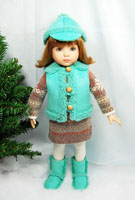
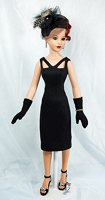
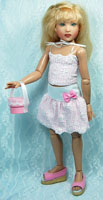
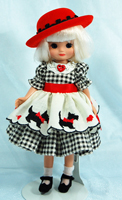
Click on picture to view table of contents To order book using Paypal and shipped via Media Mail - $19.50 |
*You will need accurate doll measurements to do this - if you are uncertain as to how take these measurements, check out the measuring/fitting page NOTE: Book recommended for beginning sewers. It contains a lot of basic sewing/fitting techniques, terms, basic fabric/thread information, hints on buying a sewing machine/serger, etc.
1. Start with the pattern instruction sheet and find the picture of the pattern pieces (it will look like the picture left above). For this tutorial I am using a pattern with princess seams. If your pattern has darts, the darts won't be marked on the pattern instruction pictures. You will have to put them in after enlarging the pieces. A basic sloper that fits the doll correctly is useful for this. 2. Make a copy of the pattern pieces shown on the instruction sheet using a copier - enlarging the page a little (I used 125% for this particular example) so that the pieces aren't quite so small. Picture can also be scanned onto your hard drive and enlarged using a photo editing program. ![]() 3. Cut out each of the pieces (from the copy sheet) that you want to use, leaving a small margin of white around the black lines of the pattern piece - the black lines will be the seamline. (After enlarging the pieces to the size required and doing any necessary alterations, seam allowances will be added.) These pattern pieces shown above are on the instruction sheet and will be enlarged to create a pattern to fit a Tyler Wentworth doll using a woven fabric. NOTE: The percentages I use in this example are for this particular exercise only. They will differ depending on what you are starting with and what doll you are creating a pattern for. For example, if you are using a costume book you will need to measure the pattern pieces in the book (following the example below on measuring the pattern picture pieces) and then follow the steps outlined to figure out the percentage of enlargement (or shrinkage). Likewise, if you are using a doll pattern and want to enlarge or shrink it for a doll that the pattern is not designed for, follow these steps once again to determine your percentage amounts.
4. Line up the pieces so that you can measure them along the bustline to I use the bust measurement to determine the percentage of enlargement for a bodice - I can more easily change the shoulder, body length, armhole size and waist. But I want the bustline to fit properly. So I mark the bust point on the pattern by taking the side front and placing a mark at the point of the greatest amount of bust curve and drawing a line across the piece (see more detail below). (To determine where the bust point is, as well as any other measurements I mention in this tutorial, see my tutorial on measuring). I then match up the other pieces to mark the bustline. I have drawn a red line showing where I will take the bust measurement of these pieces. I measure each piece across the red line (from black line to black line), add up the measurement of the 4 pieces and double that measurement (remember, you are only measuring 1/2 of the garment here). The total bust measurement of my tiny pieces at this point is 2-7/8".
5. Once I determine the bust measurement of the pattern pieces thus far, I determine what I want the final measurement to be for a proper fit on the doll (allowing for a tiny bit of ease and room for a lining- e.g. 1/4-3/8 inch). One "easy" way to figure out the % of enlargement required is to divide the end number you want by the measurement total of the smaller pieces. (e.g. - in this case, Tyler's bust measurement is 7-1/2" and I will add 1/4" ease. So I want the total bust measurement of the pattern I am "creating" to end up being 7-3/4". The copy of the pattern pieces I am using measures 2-7/8". I take 7.75 (7-3/4") and divide it by 2.875 (2-7/8") and come up with 2.69 - Formula example for enlargement: If you are shrinking a pattern, just do the opposite - in other words, divide the smaller number 6. I scan the copies of the pattern pieces individually into my computer so that I can work with them in my photo editing program to enlarge, brighten, clarify, etc. At this point I have just scanned in the 4 dress body pieces - I will work with the other pieces I want to use (the yoke/collar piece and sleeves) once I do the major fitting alterations to the body of the dress.
7. I enlarge each piece using the 269% - and print out the pieces so that I can start to measure the enlarged version to see how the "new" pattern will fit the doll. AND, to determine what kind of alterations are needed before I do a LOT of measuring of the pattern before I ever get to a mock-up stage. I do this for both human garments as well as dolls. It is just my philosophy that you can eliminate a lot of grief and get a closer fit the first time around on your mock-up by doing this. It will also get you comfortable with working with 3-D body measurements and how they translate to the flat, 2-D patterns pieces to determine fit. Additionally, whenever I am enlarging or shrinking a doll pattern to fit another size doll, I DO NOT use the doll's height to determine the percentage - this is just my personal philosophy and work approach. I always take a few key measurements of each doll and use these for determining the percentage to enlarge or shrink the pattern - e.g. on a bodice it would be the bust measurement and on a skirt it would be the hip measurement. All dolls have different porportions - just like people. So to me, using the doll's height is like saying because I'm 5'4" and you are 5'8" tall, you would use a pattern that is 106% bigger!
8. My next step is to start measuring these enlarged pieces to see what alterations I want to make before cutting out my mock-up (also called a "muslin") garment. I check the bust point measurement first to see if it is in the correct position(comparing it to what I have measured on the doll).
The bust point measurement I have measured on Tyler is 1-7/8" from mid shoulder to bustpoint. Hmmm, I've lucked out here as the bust point on the pattern looks to be just right! (It is approximately 1/16" longer - but that is close enough and allows for a tiny bit of ease). The bustline measurement on these enlarged patterns is 7-3/4" - exactly what I wanted. 9. The next measurement I look at is the 'bust point-to-bust point' to see of the princess lines will fall across the bust point as I want them too. I take the center front piece and measure it from center to bust point - I have the dolls measurement marked with a pin on the tape measure. *Remember, this front piece is only 1/2 of the total front - so the measurement must be doubled to get the total "bust point-to-bust point" measurement of the front piece.
As you can see, the shoulder line of the dress does extend slightly compared to the doll's -
HOWEVER, from doing a body assessment of Tyler I note that she has very square shoulders - and the pattern has a strong slope. So I change the shoulder line slightly to give me room to check this during the mock-up (this adjustment is done on both the front and back shoulder pieces).
10. At this point when I visually compare the pattern against the doll and I can see that there are a few areas that will need some adjustment. I take the side front piece and tape it on the doll to get a better visual - placing the bust point mark on the pattern on the doll's bust point. Tyler is VERY long waisted - as you can see from the picture below.
I mark the pattern pieces at what appears to be the smallest waistline curve, and once again draw lines across all of the pattern pieces (the dashed red line is where I have figured the waistline to be on the pattern). After taking the pattern 'shoulder to waist' measurements on both the back and fronts of the pattern piece, I compare them to Tyler's measurements. I determine that this pattern will have to be lengthened 3/4" above the waistline to drop the waistline into proper position. You can also see that this pattern skirt part is going to be way too short and will need lengthening. This is very typical of what you will find in either enlarging the instruction pieces or shrinking actual pattern pieces to create a pattern for a fashion doll. (Fashion dolls are built on a fashion drawing scale - which is approximately one head height taller than the average human. A human pattern is geared for approximately a 5'6" person.) The actual waist circumference measurement of the pattern is 6-1/2" and Tyler measures 4-1/2" - so I will leave that measurement as is for now. If I desire a tighter fit once I do the mock-up, this is an easy alteration to make during the first fitting. Also, the hip measurement is fuller than Tyler's - so once again I will make note of those adjustments in the mock-up. Both of these are easy to do in the mock-up stage - and I can see how the entire garment is going to drape before making the fitting decisions on these areas. 11. To adjust the waist length, slash the pattern pieces approximately 1/4" above the waistline marking and tape in a piece of paper to extend each pattern piece by 3/4" to drop the waistline. To help line up the pieces after they are slashed, I extend the grainline to go into the upper part of the pattern piece before I cut it apart. After taping in the extension piece I redraw the curved lines connecting the top of the piece to the bottom (see picture below right).
12. I now want to determine the total length of the dress and add the necessary extra to the bottom of each pattern piece. (The skirt can be slashed and a piece inserted just like was done for the waist length, however I prefer to add the length to the bottom of each piece so it will give the skirt a wider flare at the hemline. This is purely a personal preference.) I take a measurement of the doll from waist to the bottom of the stand (because I want the stand to be covered with this particular design) and extend the skirt to that length plus 1" for a hem.
14. Before I will fit the mock-up of this particular pattern, I need to enlarge and fit the yoke pieces. The dress must fit to the yoke. I enlarge the yoke pieces by 269% (same as the dress pieces, since this percentage worked out well) One alteration that I've found to be quite consistent when using a human pattern to create a doll clothes pattern is having to add a bit to the center back neck seam (see green wedge shape on center back of bottom yoke back piece). For whatever reason a doll's neck is straighter and/or larger in the back than a human's. I have had to make this alteration everytime I have used a human pattern to get a doll pattern. Otherwise the garment tends to
I make another mock up of the yoke and try it on the doll to see how it works - and I'm pleased so zig-zag the center front together, stitch down the seam allowance along the center front and top of the collar, and pin it together in the back. I tape it in place for ease in fitting the dress over it. (One advantage of working with a doll - you can tape pieces to her/him!) I am now ready for the first pin-fit of the dress - with seam allowances facing out (right side of the
15. After pin-fitting I mark (with a chalk pencil or fabric marker) the changes
After stitching on the new lines I remove the old stitching line, mark a new 1/4" seam allowance and trim away excess fabric. Clip curves and press seams open. In the first pin-fit I made note of the neckline shape/seam allowance I want and mark it at this point. I stay-stitch on my marked line and clip curve - turned seam allowance under, press and baste in place. The dress part is now ready for a second fit with the right side of the fabric out.
16. During the second fitting of the dress I note that there still seems to be enough room for a lining,
I also use a fabric marker to place dots along where the seamline should be on the yoke (to stitch to the neckline of the dress). I will add a 1/4" seam allowance to the yoke pieces beyond the dot markings.
17. Sleeves - I want to make a full, "drapy" sleeve (however, fitted at the sleeve cap). I look at the pieces from the pattern instructions and compare them to a pattern I already have that fits Tyler. I don't like the look of the cap, so I enlarge the straight sleeve pattern piece (from the pattern instructions) - and it looks a bit better. I compare it to the sleeve pattern I have that I know fits - the red lines show (below) where my pattern piece cutting lines are. Remember that the black lines on the enlarged piece are the seam lines, not the cutting lines. It isn't far off, so I decide to just use the sleeve pattern I have because I know it works! *Note: On a straight sleeve pattern
18. The last step is to take all of the dress (and yoke) pieces apart and make a final pattern from the pieces. The final pattern can be made from paper or a pattern fabric (this is longer lasting if you want to use the pattern many times). You are now ready to make a REAL outfit for your doll using the pattern you created.
Below are some other doll outfits I made using people patterns to get a doll pattern Bridal dress - vintage Simplicity pattern - 1957 I made the doll pattern pieces on this pattern by shrinking each individual pattern piece using a grid. Since Kitty Collier is exactly 25" of a 32" bust measurement I used 1/4" graph paper - I placed each pattern piece on a cutting mat that has 1" square.
|