SEE SEWING BOOKLETS PAGE FOR DOLL
FITTING & PATTERN MAKING BOOKLETS
Click on picture to view table of contents To order book using Paypal and shipped via Media Mail - $19.50 |
Measurements and Fitting
NOTE: Book recommended for beginning sewers. It contains a lot of basic sewing/fitting techniques, terms, basic fabric/thread information, hints on buying a sewing machine/serger, etc. The book is: These notes are primarily aimed at measuring and fitting dolls. However, I have put in some references *NOTE: MEASUREMENTS - only part of the story! There is no doubt that taking accurate body measurements will get you a better fit - either for yourself or for a doll. However, it is only part of the story as body shape is also very important. You almost can't take too many measurements! I have a costuming book that notes 90 "basic" measurements that should be taken. And then there are additional measurements listed for specific costume elements. When I worked in a large university costume shop, we took a minimum of two full pages of measurements (small print) - the actors accused us of wanting to clone them! 1. The first step is knowing where to take measurements. All of the key measurements must be noted (bust, waist, hip, etc.) as well as reference points as to where these were taken (shoulder to bust, neck to waist, waist to hip line, etc.). For example, the hip measurement is taken at the fullest part of the hip - but it must also be noted how far down from the waist this measurement is taken. So you will be taking both horizontal (around the body) and vertical measurements. After taking measurements, it is important to measure the pattern in the same places you took the body measurements to see where alterations need to be made. In the notes above I mentioned that patterns have a standardized place where the fullest part of the hip (or bust, etc.) is located on the pattern - this is usually 8-1/2 to 9" down from the waist (on a people pattern). If the fullest part of the hip is further up or further down than that, an alteration must be made to the pattern to get it to fit correctly. This reference measurement is also important to know on a doll - especially if you are using a pattern that is not specifically designed for that particular doll. You will need to look at the doll pattern closely to determine where they have placed the fullest part of the hip, where the bust line is located, etc. I have included some pictures below with blue tape lines on the doll to show where each measurement is taken. To mark reference points that will stay the same throughout the measuring process, put a rubber band or piece of masking tape around the doll's waist (where the waistband of a garment will be), around the hip (at the fullest part of the derriere) and anywhere else that would be useful depending on the design that will be made.
2. Taking The Measurements (pictures are shown below for location of these measurements on the body). *I show some of the basic measurements to take - there are numerous additional measurements that can be taken depending on what kind of garment you are working on. These are just a start. The blue lines show where these measurements should be taken: Bust High Bust
Above the bust line, around the body (This measurement is important for human ladies with a bra cup size above a B. Consider choosing a pattern by your high bustmeasurement if the other parts of the garment - shoulders, etc. - always are too big.You will have to do the alteration to your pattern to accommodate a larger cup size, but the rest of the garment should fit better.) Under bust Shoulder to bust point
This is a VERY important measurement. The bust point is where the darts should point to - however, bust darts should never be placed/sewn right up to the the bust point. They should stop shortly before the bust point - on a 16-18" doll that would be 1/8 to 1/4". On a person, the darts should stop approximately 3/4 to 1" before the bust point. On a princess line garment, the fullest part of the curve of the side front should be over the bust point (see the pattern enlargement page for a visual of this). Measurement istaken from the top, center shoulder line to bust point (on a doll the shoulder line is easy to determine because there is a seam! Bust Point to Bust Point (or the apex) Shoulder over bust point to waist Neckline
Taken around the neck where a jewel neckline would fall.
Neck to shoulder Center Back (of neck) to shoulder Center Back Back Waist
Length
Waist Hip (circumference) Waist to hip
Side Length
(underarm to waist)
Arm Length (for
sleeves) Wrist Hand Spread
Waist to floor
(or ankle) And now, THE REST OF THE STORY.......
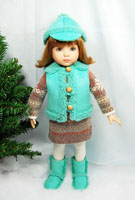
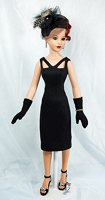
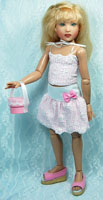
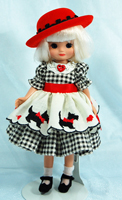
These dolls are all 15-1/2" to 16" tall - yet all have VERY different shapes. For example, one has a long torso (3rd from left); another has a tiny waist and shorter torso (2nd from left). One has very square shoulders (3rd from left) while others (2nd and 4th from left) have more sloping shoulders. Look at the differences in the hip curve and where the legs join the torso. Even the shape of each doll's legs is very different. Here's another picture to analyze:
The differences in breast shape - and position - are very apparent here. This also shows how a bust measurement may be the same but there still may have to be pattern alterations - e.g. two people with a 36" bust measurement, but one is an A cup size and the other is a C. The distribution of the measurement is very different - one person may have the larger part of the measurement in the front (the C cup person) and the other may have it in the back (for example, the A cup person who has a broad back). One way to check to get a good visual of the body shape is to do "body graph." this would be done with a doll by placing the doll on a piece of paper and drawing around the body:
When completed and placed side by side you can quickly see
*This can also be done with people. You would need a large sheet of newsprint paper! Tape to a wall or door and have the person you are measuring stand with their back against the paper and draw around the body. Once this analysis is done you may find additional body measurements you will need to take before measuring the pattern to determine alterations. Measuring the pattern to check for fit There are some alterations that can be done in the first fitting stage with your mock-up garment. This is the bodice pattern I choose to use for an example - the bodice on the left is a blouse style and thus will have different ease amounts than the fitted one on the right (the bustier is shown under the blouse on the left). How this affects the determination of fit and measuring the pattern is shown below.
***Whenever you are measuring a pattern you will not include seam allowances or darts in your total pattern measurement. An example is shown below when measuring the bust line of the bodice. Bodice
The bust circumference should be checked to make sure the blouse will have enough room to fit around the doll and over the bustier. Line up the front and back pieces and place a dotted line (orange) on both pieces so you know where to take the bust line measurement. Top picture (below) shows the line to follow across the front and back to get the bust measurement. The bottom set of pictures shows how to actually do this measurement going from center front to seam line and from seam line to dart, moving to other side of dart and to center back. Remember, this measurement must be doubled to get the total bust line measurement of the pattern.
Fold tape measure on last pin mark and you will have the total bust line measurement. The total measurement At this time I will also measure the back waist length to see if the bodice is long enough (it is). To double check this measurement, I measure the shoulder to waist (over bust) on the front piece and compare it to the doll's measurement - the pattern measures exactly 3-3/4" which is the doll's measurement. (When I cut out my mock-up I would add 1/8" to the front and back bodice length for some ease - it can always be taken back out when I do If the bodice has sleeves, I would go ahead and do this same measurement exercise on the sleeves - and make decisions based on the type of sleeve I am working with. For example, a full sleeve would need a bit of ease in the length to get the blousing at the cuff at the wrist; a long straight sleeve would have to be wide enough to go over the hand spread and length would be noted, etc. Whenever in doubt about the fit, simply add a little to the pattern piece (remembering that you've done this when you sew the seam line on the mock-up) and changes can be made Skirt
If you look at these pattern pieces carefully you will see how deep (wide) the darts are. In general, the deeper the dart the bigger the "bump" (either derriere or bust) it is meant to fit around. In this skirt, both the front and back pieces have large darts - however, Tyler has a nice flat stomach, but a full, rounded derriere. So I choose to get the 1/4" I need in the waist by making the front dart smaller (see picture below) and it will also give me a flatter front to the skirt. This is a judgment call made from experience. It is also why a really good book showing how to do alterations for different fitting "challenges" is a necessary resource. Each body shape may require a different type of alteration to achieve a proper fit and without a good reference source it is difficult to know how to determine the correct alteration.
Another exercise I did was to see how the shape of the hip line would be once the dart (back) is sewn in. I placed the pattern piece (with dart unpinned) onto a piece of paper and drew around it (see below-orange line); then I pinned in the dart. I drew another line so I could plainly see the curve. This can be an important piece of information if you have a hip curve in the pattern that isn't the same as the body that the garment is being made for. If you reference the above comparison picture of the 4 dolls (facing front) you will see that each doll's hip curve shape is very different. This is another place where patterns are standardized, but bodies are not. So the curve may have to be re-drawn if the pattern does not match the body. If in doubt, again add a little to each side seam so you can pin fit the curve at the mock-up stage.
The last thing I will check is the length of the skirt. This skirt pattern is mid-calf and I want a shorter skirt. I so determine length by measuring Tyler from the waist to where I want the skirt hem to be, add 3/8" for a hem and cut off the pattern (or fold it under) at my marking.
You are now ready to do a mock-up! (For some pictures of pin fitting the mock-up, see the |